Big LED display: how to size a large video wall
A big LED display is a modular wall, not a panel. Here is how pitch, cabinet size, weight and power set the real finished dimensions before you write the spec.
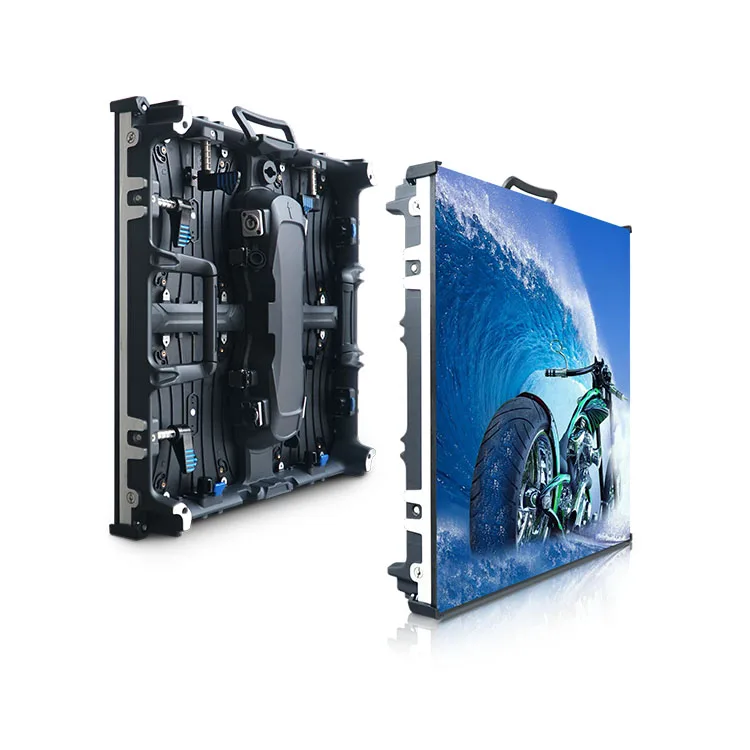
A big LED display is not a single panel you hang on a wall. It's a modular direct-view wall built from cabinets, modules, power supplies and data cabling, and the finished size is whatever whole number of cabinets you bolt together. That single fact changes how you plan everything: pitch, structure, circuits and the content you'll run.
We make the hardware. Hopestar was founded in 2006 and is an OEM/ODM manufacturer of display hardware based in Longhua, Shenzhen, China. We supply LED display cabinets, modules, power and data, plus commercial Android tablets and POS terminals. We don't supply the structure, the rigging, the video processor, the sending card, the content management software, or installation. Those are yours or your integrator's scope, and we'll say so again later because it's the part buyers get wrong most often.
What Counts as a Big LED Display: Size Ranges and Where They Are Used
Industry convention splits walls into rough bands. A small indoor wall runs about 3 to 6 m wide: retail windows, meeting rooms, small lobbies. A large indoor wall runs about 6 to 15 m: lobbies, control rooms, auditoriums, transit concourses. Outdoor advertising and stage walls run 10 to 50 m and beyond, because they're viewed from a road or a stadium seat rather than from across a room.
Those bands aren't rules. They're a shorthand for what the wall has to do. A 4 m wall in a bright lobby needs more brightness than a 12 m wall in a dim control room. A 20 m outdoor wall needs a structural engineer and a wind load calculation; a 4 m indoor wall usually needs a rated anchor into a solid wall and little else.
Your choice of indoor or outdoor hardware comes first, because brightness, IP grade and cabinet family all follow from it.
Pixel Pitch and Viewing Distance: How to Choose the Right Pitch for a Big Screen
Here's the rule of thumb most integrators use. The minimum comfortable viewing distance in metres is roughly equal to the pixel pitch in millimetres. P3 is comfortable from about 3 m. P6 from about 6 m. P10 from about 10 m. It's a starting point, not physics, but it keeps you from over-specifying pitch on a wall nobody will stand next to.
Work it backwards and you get the formula that matters: minimum pitch (mm) = closest viewer distance (m). Measure from the wall to the nearest place a person can stand, then pick the coarsest pitch at or below that number. If the closest viewer is 5 m away, P5 or finer is comfortable. If the closest viewer is 12 m away, P10 or P12 will look fine and cost less.
| Pitch band | Closest comfortable viewer | Typical use |
|---|---|---|
| P1.875 to P3 | About 2 to 3 m | Close indoor: retail, meeting rooms, lobbies |
| P3.9 to P6 | About 4 to 6 m | Mid indoor and mid outdoor: concourses, entrances |
| P6.67 to P16 | About 7 to 16 m | Large outdoor advertising, stages, stadiums |
Pitch drives cost the same way it drives resolution. For a fixed wall size, a finer pitch means more pixels, more modules per cabinet, more receiving cards and a higher cost per square metre. So set pitch by the closest viewer, not by the largest number on a spec sheet. A P3 wall seen from 15 m looks the same as a P10 wall seen from 15 m, and the P10 wall leaves money for the structure.
One more thing. The same pitch can appear in indoor and outdoor families, but brightness and IP rating change which one you order. Our outdoor line includes a 500x500 mm die-cast cabinet at P2.97 and P3.91, 5,000 nits, 1920-3840 Hz refresh, with max/avg power of 1000/450 or 875/300 W/m2. At low dimming levels, the way a driver modulates current or a switching waveform can produce perceptible flicker, and IEEE Technology Navigator notes that PWM can cause perceptible flicker at low duty cycles if the frequency is below approximately 1000 Hz.
Cabinet and Module Sizes: How Big a Wall You Can Actually Build
Finished wall width and height are always a whole number of cabinets. That's the calculation buyers skip. You pick a target size, then round up to the nearest cabinet multiple, and the wall grows.
Cabinet sizes in our LED display line include 500x500 mm die-cast, 960x960 mm, 500x1000 mm and 512x512 mm. Module sizes include 320x320 mm, 240x240 mm and 500x500 mm, depending on family. Say your target is 6 m x 3 m using 500x500 mm cabinets. That's exactly 12 cabinets wide by 6 high, so the wall is 6.0 m x 3.0 m. Clean. Now say the target is a bit over 6 m wide. Twelve cabinets give you 6.0 m and thirteen give you a wider wall. You can't build a fraction of a cabinet, so the wall grows and your structure, your trim and your content aspect ratio all shift with it.
Run that check before you sign off on the drawing. It's the difference between a wall that fits the opening and a wall that needs the opening modified.
Mixing cabinet sizes in one wall is possible. It complicates the structure, the spare parts list and the service procedure, so most projects pick one cabinet family and stay in it.
Weight, Load and Structure: What the Wall and the Building Must Carry
Total wall weight is cabinet weight times cabinet count, plus the mounting structure, plus the trim. The mounting structure and the building anchor must be rated for that total with a safety factor. That's your engineer's calculation, not ours.
The one load figure we can publish: our LED display mounting hardware is tested to 800 kg load capacity. Load is usually expressed per cabinet and per square metre, and both numbers go to the structural engineer so they can confirm the wall, truss or ground support can take it.
Outdoor walls add wind load. That's a structural calculation the buyer's engineer must run against local code, and it's why outdoor walls often need a deeper foundation or a heavier frame than the display hardware alone would suggest. Hopestar does not provide structural engineering, rigging design or installation. We don't have field crews and we don't sell that service. If a supplier quotes you a wall and a structure from one drawing without an engineer's stamp, ask who stamped it.
Power and Data Planning for a Large LED Wall
Two power numbers matter, and they're different. Max power per square metre is what the wall draws at full white. Average power is what it draws with real content, typically 30 to 40 percent of max. Size the circuits on max. Estimate running cost on average.
From our spec tables: indoor walls run 600 to 680 W/m2 max, outdoor 550 to 1100 W/m2 max, rental 600 to 800 W/m2 max, and floor 800 to 1200 W/m2 max. Multiply max W/m2 by wall area to get the worst-case draw, then divide by your supply voltage to get current.
Branch circuit planning is where code comes in. The NFPA 70 Section 220(F) states that sign and outline lighting outlets shall be calculated at a minimum of 1200 volt-amperes for each required branch circuit specified in 600.5(A), so a large sign load isn't sized like general lighting. The NEC also sets general lighting at 33 volt-amperes/m2 in Section 220(B), which is a different calculation entirely. Your electrician owns that call.
Data is simpler. Cabinets are daisy-chained, and power is distributed per cabinet row or column, so the number of circuits depends on cabinet count and max W/m2. The video processor, sending card and content source are supplied by you or your integrator, not by Hopestar. Plan the signal path before the cabinets arrive, because the receiving card position and the cable runs are set at the cabinet.
Indoor vs Outdoor vs Rental: Which Big LED Display to Specify
Brightness separates the families more than anything else. Indoor runs 800 to 1200 nits. Outdoor runs 5000 to 7500 nits. Indoor rental runs 800 to 1200 nits, and outdoor rental runs 3500 to 5000 nits. If the wall faces direct sun, indoor hardware will look grey no matter what you feed it.
IP grade separates them next. Rental indoor is IP30, rental outdoor is IP65. Floor series are front IP65 / back IP32 or front IP45 / back IP67 depending on the series. Fixed indoor walls don't carry an IP grade in our tables.
Pitch ranges per family: indoor P2 to P6, outdoor P2.97 to P16, rental P2.6 to P4.81, transparent P2.6 to P10.416, flexible P1.875 to P4, floor P2.97 to P8.9. Cabinet sizes differ too, which is why you can't swap a rental cabinet into a fixed indoor frame without a new drawing.
Outdoor and rental walls need a different structure and rigging approach than fixed indoor walls. Rental cabinets are built for repeated assembly, so they have quick locks and a flight case, and the rigging points are part of the cabinet. Fixed indoor walls usually hang on a frame you build. Hopestar supplies the display hardware only.
What Hopestar Supplies and What You Supply
We're an OEM/ODM manufacturer of LED display hardware, which means cabinets, modules, power supplies and data. We also make commercial Android tablets and POS terminals, and we don't make mounting structures, trusses, rigging, video processors, sending cards, content management software, or installation.
LED displays carry a 3-year warranty. OEM scope covers logo, manual, packaging, labels and firmware changes. Samples are available, and trade terms are FOB, CIF, CFR or EXW from Shenzhen. Every finished unit is inspected for appearance and function, and LED screens are tested and assembled twice before shipment.
Before you request a quote, put these on one page:
- Target wall width and height, and the opening it must fit
- Indoor, outdoor, rental, transparent, flexible or floor
- Closest viewer distance in metres, so we can confirm pitch
- Cabinet size preference, or let us propose one
- Max W/m2 and supply voltage available at the wall
- Quantity: how many walls, and spare cabinets or modules
- OEM items: logo, packaging, labels, firmware
Send that to our contact page and we'll come back with a cabinet layout and a bill of materials. Inquiries are answered within 24 hours. We publish no prices, so a real quote depends on the configuration you send us.
Common questions
What is the largest LED screen?
There's no fixed ceiling, because a big LED display is modular. Outdoor advertising and stage walls commonly run 10 to 50 m wide and sometimes larger. The limit is the structure, the power supply and the budget, not the cabinets. Send us a target width and height and we'll tell you the nearest cabinet multiple.
What is the largest LED display size available?
Size is a cabinet count, not a catalog number. Our cabinets include 500x500 mm, 960x960 mm, 500x1000 mm and 512x512 mm, and you can tile them as far as your structure and power allow. The practical answer is whatever your engineer and your circuit count will carry.
How do I calculate the size of a big LED display from cabinets?
Divide your target width by the cabinet width, round up to a whole cabinet, then multiply back. A target just over 6 m on 500x500 mm cabinets rounds to 13 cabinets, so the wall grows to the next whole cabinet. Do the same for height. The wall is always a whole number of cabinets.
How far should viewers sit from a big LED display?
Minimum comfortable viewing distance in metres is roughly equal to the pixel pitch in millimetres. P3 is comfortable from about 3 m, P6 from about 6 m, P10 from about 10 m. Measure to the closest place a person can stand, then pick the coarsest pitch at or below that number.