RK3576 and the Rockchip line: choosing a tablet platform
The RK3576 is the newest Rockchip SoC in our commercial Android tablet line, but it is not always the right pick. This guide compares RK3288, RK3399, RK3566, RK3568 and RK3576 on cores, NPU, video decode, display outputs and the Android versions we list on each chipset.
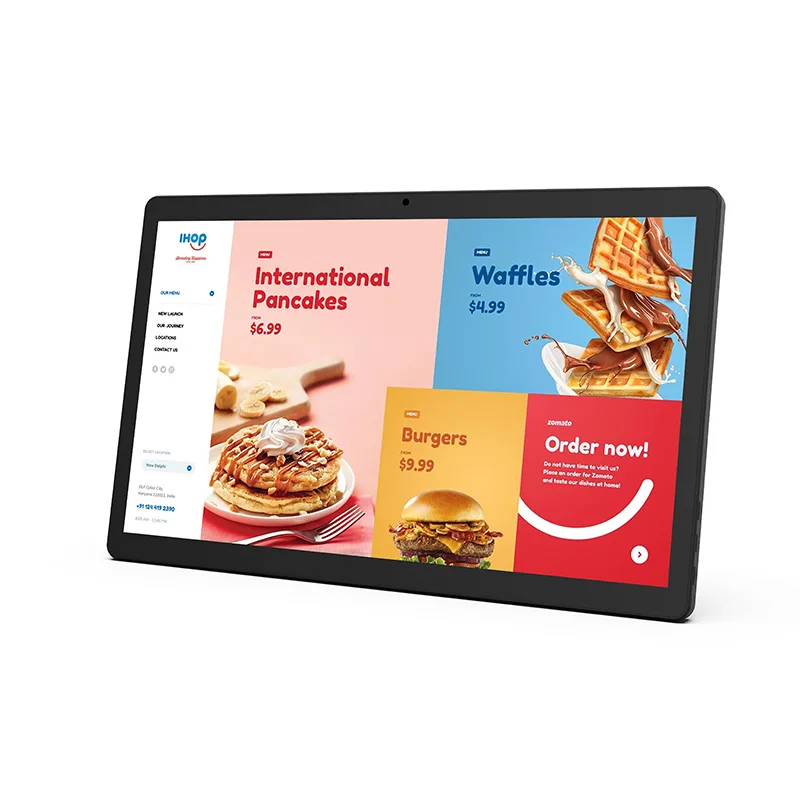
The RK3576 is our newest Rockchip SoC in the commercial Android tablet line. But it's not always the right pick. We see plenty of RFQs that name a chipset without saying what the device does all day. That's backwards. The workload picks the SoC-not the other way around. This guide walks through the five Rockchip platforms we use in tablets. What each one is good at, and when it's worth moving a design. See our 32 inch display for the specifications.
Rockchip SoC comparison for commercial Android tablets
We hear this question constantly-five-way splits between these chips. The table below pulls core layout and process details from Rockchip's own RK3576 datasheet, plus SBCwiki pages for the Rockchip RK3568 and Rockchip RK3566. Android versions? Those come from our spec tables.
| Chipset | CPU cores | Process | NPU | Video decode | Display outputs | Android we list |
|---|---|---|---|---|---|---|
| RK3288 | Quad Cortex-A17 | - | - | - | - | 5.1, 6.0, 8.1 |
| RK3399 | Dual Cortex-A72 + quad Cortex-A53 | - | - | - | - | 7.1/9.0 |
| RK3566 | Quad Cortex-A55 up to 1.8GHz | - | - | 4Kp60 H.264/H.265/VP9 | - | 11 |
| RK3568 | Quad Cortex-A55 up to 2GHz | 22nm | 0.8 TOPS or 1 TOPS | 4Kp60 H.264/H.265/VP9 | RGB, LVDS/MIPI DSI, HDMI, eDP, Eink | 11 |
| RK3576 | Quad Cortex-A72 + quad Cortex-A53 | 8nm | 6 TOPS INT8 | 4K 120fps HEVC/VP9/AV1 | HDMI v2.1, eDP v1.3, MIPI DSI, DP v1.4 | 14 or 15 |
Two things pop. RK3288 is still the only one with Android 5.1 and 6.0 builds we list. And RK3576 stands alone with a published NPU and 4K 120fps decode. That gap? It's why some projects stay put and others jump.
RK3576 core layout, process and NPU
Quad Cortex-A72 plus quad Cortex-A53, big.LITTLE style. That's straight from the Rockchip RK3576 datasheet. Same big-core cluster as RK3399, but on a newer process. 8nm, per the datasheet. Memory support? LPDDR4, LPDDR4x, LPDDR5 all work. Storage? eMMC 5.1, SDIO 3.0, SFC, UFS v2.0.
The NPU is the headline. Rockchip rates it at 6 TOPS INT8. It supports int4, int8, int16, FP16, BF16, TF32. For a fixed-install tablet doing on-device inference, that's a big shift from RK3568's 0.8 or 1 TOPS. You can run a lightweight vision model or keyword spotter without a cloud round trip. We won't benchmark it here. Too many variables in model format and runtime.
RK3576 video decode and display outputs
RK3576 pulls away on video decode. H.265 HEVC Main10 L5.1 yuv444 at 4K 120fps, VP9 Profile0/2 L5.1 at 4K 120fps, AV1 Main10 L5.3 at 4K 120fps-that's what the Rockchip RK3576 datasheet lists. For H.264 AVC High10 L5.1 yuv422, you get 4K 60fps. Encode runs 4K@60fps for H.264 and H.265.
Display side, it's an HDMI v2.1 / eDP v1.3 combo, a 4-lane MIPI DSI, and a DP v1.4 / USB 3.0 combo on Type-C. Rockchip says it can drive multiple displays: 4K@120 plus 2.5K@60 plus 2K@60. Overkill for a 15.6-inch panel? Sure. But it matters if a customer wants a tablet that also feeds a second screen or a video wall tile.
Android versions Hopestar lists on each chipset
This part trips people up. Chipset support and what we list on a model? Not the same thing. Per order, we build AOSP images. The listed OS depends on the board support package. And what the customer’s app needs.
- RK3288: Android 5.1, 6.0, 8.1, or no version listed.
- RK3399: Android 7.1/9.0, or no version listed.
- RK3566: Android 11, or no version listed.
- RK3568: Android 11, or no version listed.
- RK3576: Android 14 or Android 15.
Need Android 14 or 15? RK3576’s the only Rockchip option we list. Stuck on Android 5.1 for a legacy kiosk app? RK3288’s the one that still shows it.
Why long-running projects stay on RK3288
Suggesting a chip from that era? It sounds odd, I know. But RK3288 still shows up more than any other chipset across our wall-mount and desktop tablet models. The WA1342T runs Android 5.1/8.1, the HS-SHT1568 runs Android 8.1, and the WF2402T runs Android 5.1/8.1. A quad Cortex-A17 at 1.6GHz handles fixed-function signage or kiosk workloads without breaking a sweat. The app got qualified years ago. Firmware? Rock solid. Peripherals? Proven and boring, which is good.
Swapping the chipset isn't a drop-in job. You'd have to re-qualify the bootloader, the kernel, display timing, the touch controller, the PoE power path, all the certifications. That's real engineering time, and real risk. Product still selling? OS still meets the customer's security policy? Then don't move. That's precisely why we keep RK3288 models around.
When to move to RK3576
Four clear triggers. Do you need Android 14 or 15 on a Rockchip tablet? No other chipset in our line lists those versions. Or maybe you want on-device NPU inference. The 6 TOPS INT8 figure is a published Rockchip spec-enough for a local vision model or a small transformer. Need 4K 120fps decode or multiple high-resolution display outputs? That's another sign. And if it's a new design, you'll want LPDDR5 and UFS v2.0 headroom. That's the fourth trigger.
Say a buyer is building a meeting room panel. It'll run a local face recognition model and drive a 4K confidence monitor. That's an RK3576 job. But a buyer who just needs a 10.1-inch ordering tablet with a fixed Android 11 image should stay on RK3566 or RK3568.
Hopestar tablet models by Rockchip chipset
Here's how the models split by chipset. It's the same breakdown you'll find on each product page. A few boards, like the PW-1537T, show multiple chipset options. That means the board supports more than one, and we build per order.
| Chipset | CPU cores | Android listed | Models |
|---|---|---|---|
| RK3288 | Quad Cortex-A17 | 5.1, 6.0, 8.1 | HS-SHT1568, WA1342T, PW-1537T, WL1718L, H2152T, WF2402T |
| RK3399 | Dual Cortex-A72 + quad Cortex-A53 | 7.1/9.0 | WL1589T, HP1733T, HG805G, HGN801 |
| RK3566 | Quad Cortex-A55 | 11 | WA1036T, WL1026T, WA1412T, PW-1537T |
| RK3568 | Quad Cortex-A55 | 11 | WL1338T, WH1336T, PW-1537T, HP525 |
| RK3576 | Quad Cortex-A72 + quad Cortex-A53 | 14 or 15 | WL1338T, WF1589T, SIN-H32 |
We don't list an RK3588 model. If you need RK3588, we're not the right supplier for that part.
What to send us for a quote
Writing in for a quote? Send three things. Screen size and form factor come first: wall mount, L-shape desktop, or rugged handheld. Then the Android version your app needs. Last, the workload-video playback resolution, any on-device inference, and whether PoE, NFC, or a second display output matters to you. That's all we need. We'll recommend a chipset and a model. Use the contact page. We'll answer within 24 hours.
Common questions
What is the NPU performance of RK3576?
Rockchip's RK3576 datasheet lists a 6 TOPS INT8 NPU with support for int4, int8, int16, FP16, BF16 and TF32. That's a published figure for the chip, not a benchmark on our tablets. Real throughput depends on the model format, runtime and memory bandwidth.
Does RK3576 support 4K 120fps video decoding?
Yes. The Rockchip RK3576 datasheet lists H.265 HEVC Main10 L5.1 yuv444, VP9 Profile0/2 L5.1, and AV1 Main10 L5.3 all at 4K 120fps. H.264 AVC High10 L5.1 yuv422 decodes at 4K 60fps. Encode is 4K@60fps for H.264 and H.265.
Which Android version does RK3576 support?
On Hopestar tablet models, RK3576 lists Android 14 or Android 15. The WL1338T lists Android 15, while the WF1589T and SIN-H32 list Android 14. We build AOSP images without Google Mobile Services, so the exact build is per order.
What is the difference between RK3576 and RK3588?
We do not make or list an RK3588 model, so we cannot compare them from our product line. From the datasheets, RK3576 is a lower-cost part with a quad A72 plus quad A53 CPU, 6 TOPS NPU, and 4K 120fps decode, while RK3588 has more CPU cores, a bigger GPU, and more display pipelines. Ask an RK3588 module vendor for their specs.